Saturday, September 12, 2009
Next batch of journal quilts
4 quilts on 2 themes, bottles and boats. The 'bottles' are made with clingfilm with threads etc trapped between layers and ironed (don't forget to iron over baking parchment).
Friday, August 21, 2009
Holiday time . . .
. . . in the Peak District of Derbyshire. [I started this message ages ago, and gave up because it wouldn't let me move the pics around. Coming back to have another go today, 12 Sept, I still can't do it and have decided to post anyway. So they are a bit muddled! But hopefully nice to look at!]
Well dressings are a feature of summer life in the Peak villages and this was one of 3 in Bradwell, neat Great Hucklow where we had a cottage. The pictures are made with flower petals, leaves, seeds, all sorts of plant pieces.
Another place we visited is Eyam, a village famous for cutting itself off during the Plague in 1665 so that the infection wouldn't spread. Nice Celtic design cross in the churchyard.
Well dressings are a feature of summer life in the Peak villages and this was one of 3 in Bradwell, neat Great Hucklow where we had a cottage. The pictures are made with flower petals, leaves, seeds, all sorts of plant pieces.
Now this is in the gardens at Chatsworth! Talk about dodging around! Its a viewpoint
from which you can lock down over the rock garden.
This isn't a stately home but the cottage we stayed in, at least, the lefthand end of it is!
Flowers at Chatsworth.
WE had the use of the patio at our cottage and very nice it was in the sun, though here it was raining!
Here's a nice old stone house, typical of the area, local stone. It is in Eyam, one of a number of cottages where the plague victims who died in the house are listed on a board outside. So many from each family, so sad.
. . . and the famous fountain at Chatsworth.
We were there with grandchildren so a visit to the farm was obligatory, and most entertaining with these little rascals wriggling and sucking.
Another visit was to Caudwell's Mill where they have examples of different sorts of grain growing and sell lovely flower ground on the premises in the historic mill.
Saturday, July 18, 2009
It was well worth . . .
. . . digging up the front garden. It is a riot of green at the moment . . . 
. . . outdoors. . .
. . . and indoors . . . yummy yummy
But where these (below) came from we have no idea! Funny, times when I think out carefully what to grow where, go and buy it, get it planted in just the right place etc etc, the stuff doesn't always grow. Other times things just appear, don't know where from, in places you would never choose, and flourish amazingly. Is there a life message there somewhere??? If you think you know what it is, please tell me! Meanwhile they brighten up the bed with the brussel sprout plants in.
I'd like really to have these poppies in the back garden alongside these . . . a pink geranium that survived from last year, an unusual geranium-type plant from the local garden centre and fuchsias bought at a sales table at church.
If your local allotment waiting list is too long, an alternative is to find an elderly person who is willing for you tidy a bit of their garden by digging a veg patch in return for some of the produce. Derek has been able to do this and as well as strawberries, peas and broad beans we have had these . . .
. . . and these come from our own greenhouse, doing a bit better than last year. Red and green again, but perhaps a bit more attention to the background when taking pix might be a good idea!
Nice printed batik though, from Togo in West Africa, bought at a craft village when we visited friends doing linguistic, literacy and Bible translation work there, in 1994.

Monday, June 29, 2009
Fabric salvage now . . .
. . . bits and pieces not much use for anything else, sometimes rescued from other people's bins at workshops (how sad is that?).
This is one of the first set of postcards I ever made, discovered tucked away somewhere when having a workroom clearout recently.
I think it is the colour grouping that makes these interesting.


The compulsion to make these strip things seems to go on for ever, but at last I am moving on a bit . . .
. . . though not for long. Back to strips, but thinner, even more likely to be in the bin, and running stitch all over them . . .


These bags also use up all sorts of offcuts - strips, trimmings and tiny scraps any normal person would just throw away. Lay them out on a piece of fabric cut to the size required for what you want to make. Cover with organza (stripy bag) or net (blue/red bag), pin everywhere then machine stitch all over, handling carefully so bits don't escape. Of course you could use fusible web but I hate the stuff. This bag is done with straight stitch, to show that you don't have to be able to do free machining to use this method of creating fabric.
This is one of the first set of postcards I ever made, discovered tucked away somewhere when having a workroom clearout recently.
Not just me . . .
. . . doing creative things . . . e.g. making racks for our patio pots.
Since we moved back here to Dorset Derek has been salvaging pallets from houses locally where some building work is being done (with permission of all concerned of course). He was horrified to discover that pallets on which various building materials were delivered just got taken to the local landfill, not returned to anyone for reuse. People seem very happy for him to take them, it saves them a job dumping them.
Saturday, June 20, 2009
WCE June Exhibition
On the transfer paints day an exhibition was set up of work from the Poole branch of WCE at Upton House, a local council owned manor house plus grounds which is a great place for a day out. Years ago Prince Carel of Rumania was living there, and got behind with his rent I believe. The most upmarket council house in the country we used to joke among ourselves. There is a small gallery above the cofee shop which has regular exhibitions of various kinds. This was the first time the group had exhibited, and there was a lot of impressive work to look at. The pix can be clicked on for a larger version, where the separate elements of the collages can be seen more clearly.
There were framed pictures, cushions, bags, boxes, pin cushions, book covers, small hangings, postcards, journal quilts. To hang things on the walls you have to knock nails in, then fill in the holes afterwards and restore it to its previous condition. We didn't want to cope with that so we had mostly smaller items, the sort of things embroiderers tend to make compared with quilters.
There were framed pictures, cushions, bags, boxes, pin cushions, book covers, small hangings, postcards, journal quilts. To hang things on the walls you have to knock nails in, then fill in the holes afterwards and restore it to its previous condition. We didn't want to cope with that so we had mostly smaller items, the sort of things embroiderers tend to make compared with quilters.Readers of Stitch magazine may spot a few things made from articles in that. And a surprising number of items from our monthly workshops turned up, finished and looking smart.
We all made items for the sales tables, top pic bottom left, to raise a bit of money. General consensus seems to be that it was a very successful event, and it has given us confidence for another one in the future.
Labels:
embroidery,
exhibition,
West Country Embroiderers
Exciting stuff at WCE . . .
. . . in June. Eileen Pugh, one of our members, gave us a great workshop on using fabric transfer paints. She showed us 2 lovely pieces her sister had done in the past, colouring her fabric and then adding stitching.
With this to inspire us we painted away, on paper, using drawings Eileen provided of flowers and butterflies. The iris one was popular. The idea is then, when the paint is dry (a hairdryer helps speed things up. I seldom use mine for drying hair!), you lay the painted paper down on fabric and iron it carefully. The heat releases the colour. Polyester absorbs it very efficiently, so we tried out pure polyester and polycottons. Colour does come off on natural fibres alone but needs special treatment to fix it.

With this to inspire us we painted away, on paper, using drawings Eileen provided of flowers and butterflies. The iris one was popular. The idea is then, when the paint is dry (a hairdryer helps speed things up. I seldom use mine for drying hair!), you lay the painted paper down on fabric and iron it carefully. The heat releases the colour. Polyester absorbs it very efficiently, so we tried out pure polyester and polycottons. Colour does come off on natural fibres alone but needs special treatment to fix it.Wednesday, June 17, 2009
Two UFO's done, 999+ to go . . .
A few months back we did this Banjara-style stitching with Tiggy Rawling at West Country Embroiderers. I've now finished my bit and have made it into this bag, with dangling elephants and cords made of twisted sari threads.
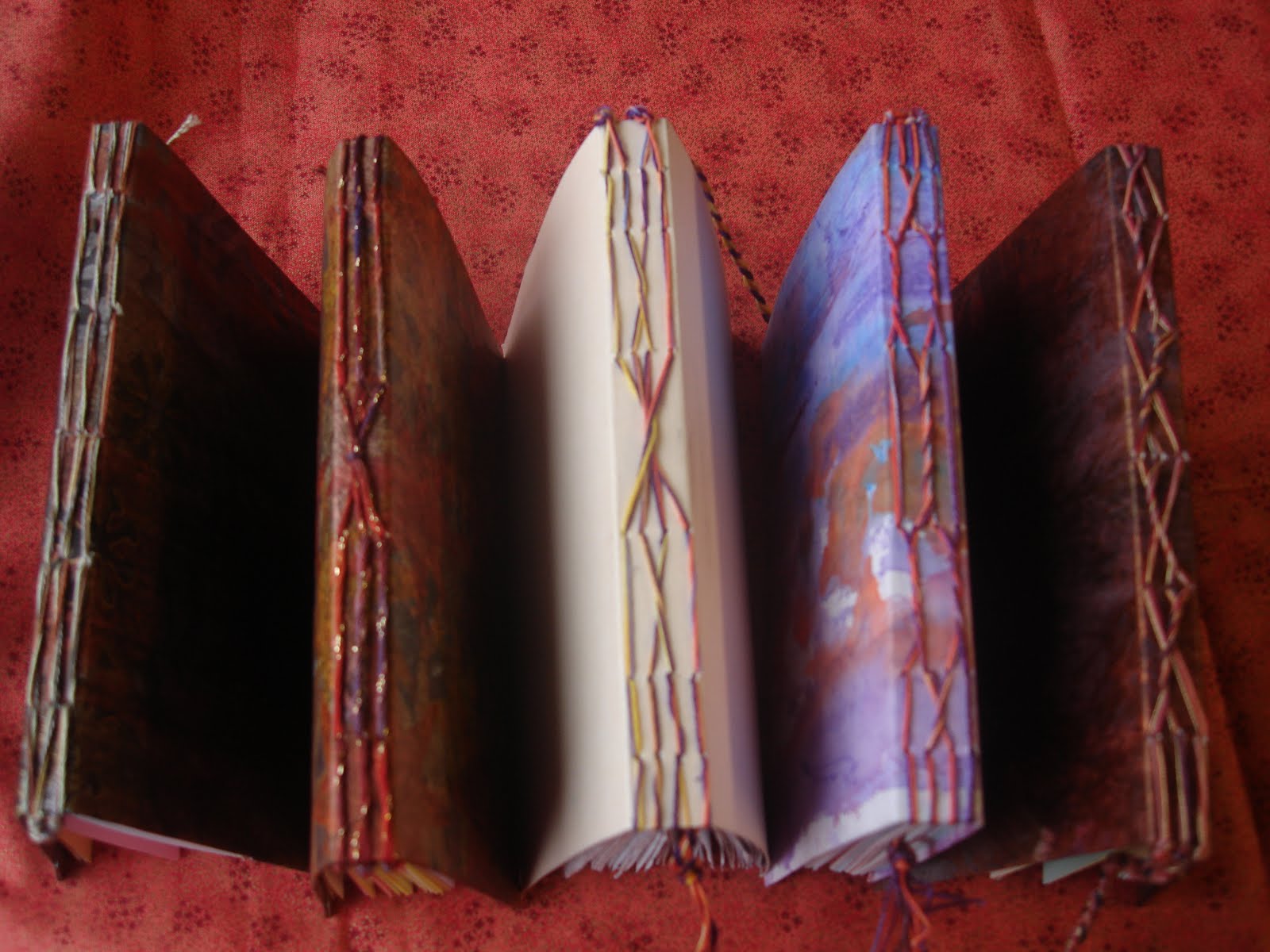
And these are my folder covers, not given pages yet (I'm still figuring out how to organise the holes), done with Wendy Jackson.
The outer fabric is a piece of batik done at a workshop at Quarry Bank Mill in Cheshire several years ago. The inside fabric was done one day dyeing with a friend. It is a bog standard Dylon dye, bronze rose, and has separated out into interesting bits of colour, adding nicely and unexpectedly to the intended splodgy effect of crumpling into a jar.
Labels:
batik,
cretan stitch,
embroidery,
India,
making books
Studies in red and green . . .
Sunday, June 07, 2009
creative stuff at church . .
. . . just over life-size figures, the Rhythm of Life band, made by weaving strips of fabric, plastic, paper in and out of chicken wire moulded over a wooden armature. The instruments are constructed out of card covered with paper, painted gold. This was a project lots of people had a go with, anyone who was in the church building for whatever purpose was encouraged to put some strips in, and they did. There's a guitarist, drummer . .
. . . trumpeter, saxophone player (well, nearest we could get to a saxophone!)
. . and a violinist. Interesting mixture. I wonder what that would sound like if they all came alive one time and started to play?
The figures were constructed and the work facilitated by Jacqi Lea, a community artist from Southampton.
Then this is done by a group of us who've been involved in making altar covers. See same link as the band (above). We made a strip each,using a drawing of an idea one of us had, relating to the Hard Rain exhibition we have at the church till October. There is a lot of detail in the embroidery, worth a click to see a bigger picture.
This was on the lable that went with it.
The Hard Rain pictures are mostly pretty bleak and that is how our ‘story’ begins. But stubborn little green shoots eventually penetrate the dark landscape and expand into green places where the rhythm of growth takes over , producing fruit that continues the cycle of new life. And the tree spreads out across all of it.
Subscribe to:
Posts (Atom)


There was so much to show at the end I've had to make 2 collages to display it all.