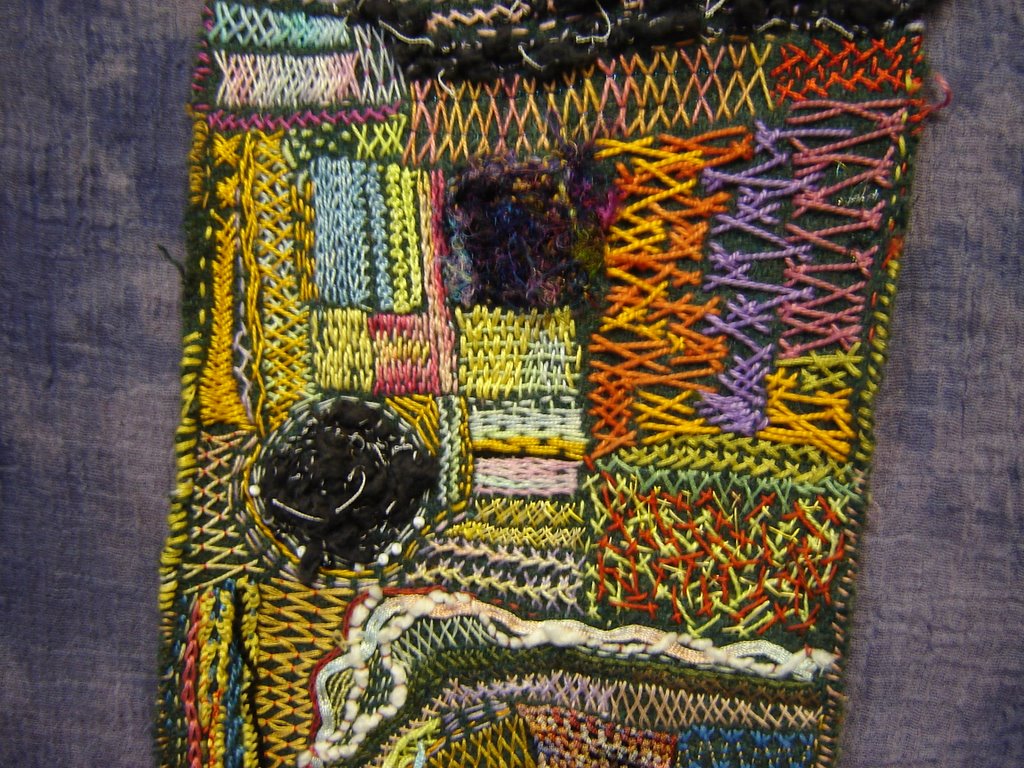
Showing posts with label stitches. Show all posts

Tuesday, February 16, 2010

Lumps and Bumps . . .


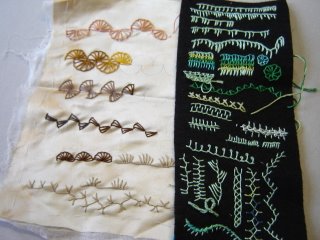
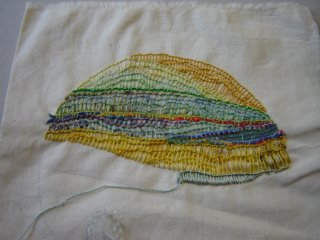
. . . workshop for West Country Embroiderers.  Not a very elegant title!  I can't remember now if it was my creation or our programme secretary's when we were discussing what I was going to do!  Also known as 'calico gardens' or just textured stitches.  Traditionally it is done all in creams, on calico . . .
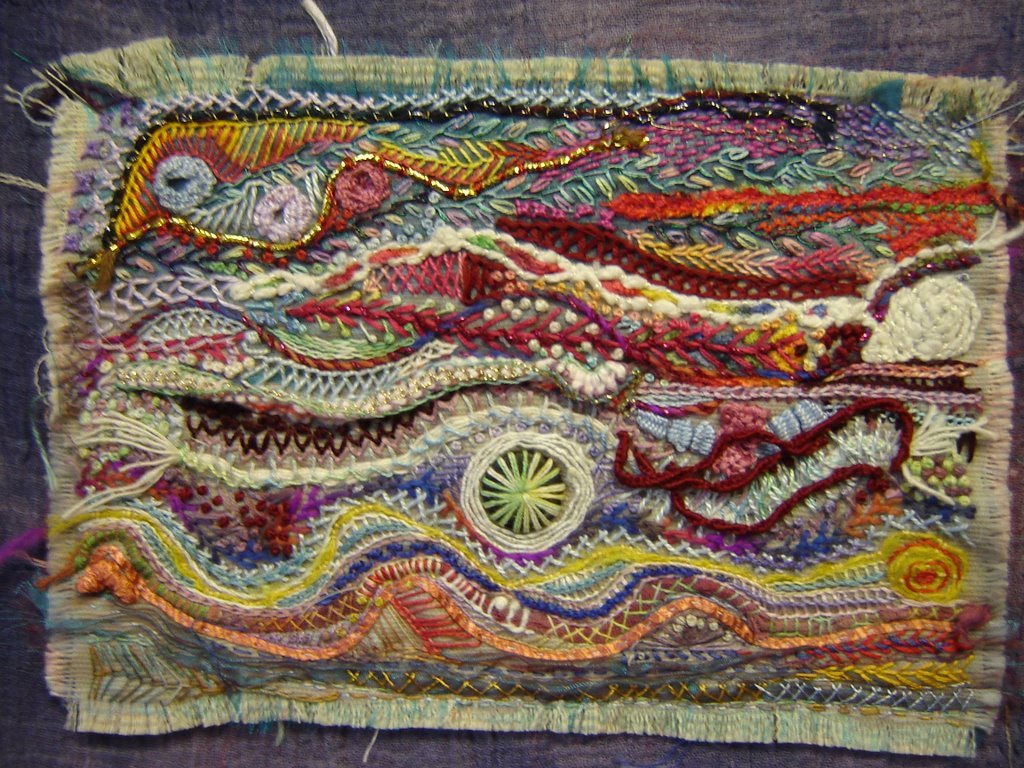
(no prizes for composition for the above, but it does include a lot of different ways of doing this work)


. . .but I thought - why not colour? and stitched a red tree . . .

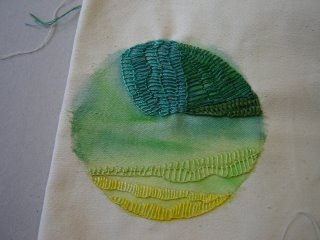
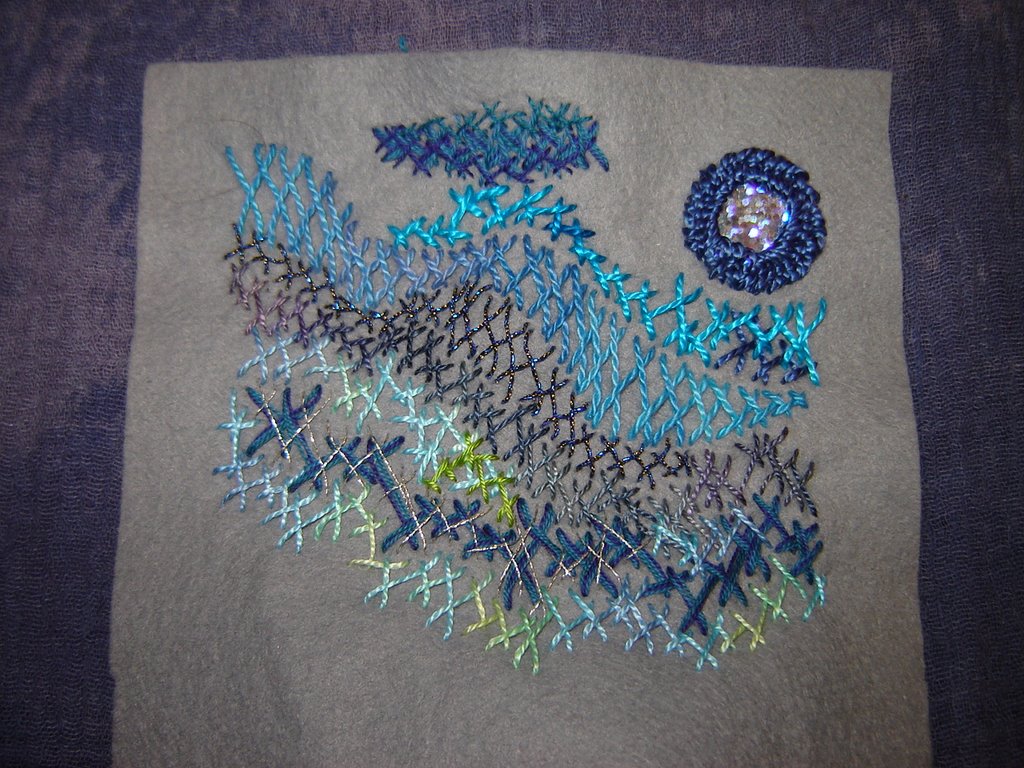
. . .closely followed by an undersea sort of scene in blues . . .


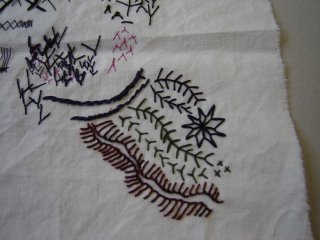
. . . and a doodle in greens and pinks.

Another element I like to include in this is doing 'normal' stitches, like cross stitch, herringbone, and then wrapping them, buttonholing along them or weaving across them.
Oversewing objects that don't generally get included in embroidery is another option.  Guess the objects.  No prizes!

Varying thick /thin threads is rather fun too.  (Knotted cretan stitch)
Unfortunately I didn't get to take photos of people's work this time.  Sorry everyone!

Monday, December 22, 2008

Back stitch . . .

. . . for the Stitchin fingers stitchalong.
If you follow the link above you will understand what this is all about. I'm very keen on this business of exploring surface stitches, and get on better with doing it in some kind of organised challenge type of thing. This stitchalong is ideal. A list of stitches is provided, there is free choice of stitch to work with and no deadline except the expectation of other participants that there will be regular examples to look at. So here is my first effort. I decided to work through the list picking a stitch from each letter of the alphabet. And have immediately broken my 'rule' by starting with B! Ok, ok.
I couldn't think of many really different things to do with back stitch, but tried varying length and thread, and also featuring the back of the stitch on the right side as it is rather interesting, like an untidy stem stitch. I've also done back stitch along chain stitch, and whipped and threaded lines of stitching, and put beads on. Haven't tried pekinese lacing yet. In the top pic I was seeing what it looked like working a lot of lines of stitching close together to cover the ground. I did one like this with running stitch (in an earlier post) and wanted to compare the effect. Some is a kind of semi-back stitch, taking the backwards stitch and then bringing the needle out at the end of the stitch instead of ahead of it. This has a slightly different look, kind of alternate bumpy and flat. (And saves thread of course. Back stitch does use a lot more thread than shows on the surface).
The second pic has a row of zigzags, still backstitches, but angled. I could pursue this to see how it covers an area.
I also decided to do these samples in postcard format. That gives the option of perhaps making them into some kind of book, or stringing them together in some way.

Thursday, November 22, 2007

TAST latest

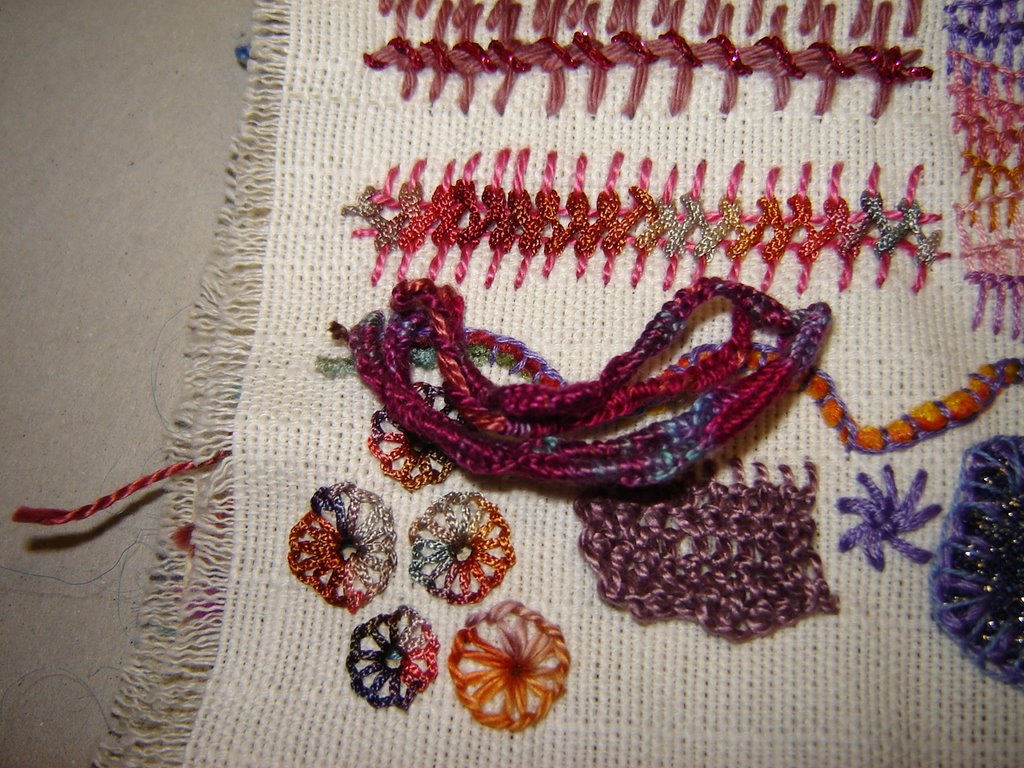
There are only 3 more weeks to go with this challenge. The year has gone quickly! This is mainly pekinese stitch (week 45) and a small chunk of chain braid stitch (46). Didn't like the latter much, it kept falling over, as Sharon did warn us it might, and I tied it down with small stitches. 47, thorn stitch needs more examples to be done but a start has been made. I still have quite a bit of space left on this strip, (rolled up on top of the chair), so I may revisit some of the stitches that I didn't do much with and see if further inspiration is forthcoming.

Saturday, September 29, 2007

TAST update

There's a mischmasch here of the last 2 stitches, plus some infilling. This panel will be finished shortly.

Sunday, September 02, 2007

TAST latest


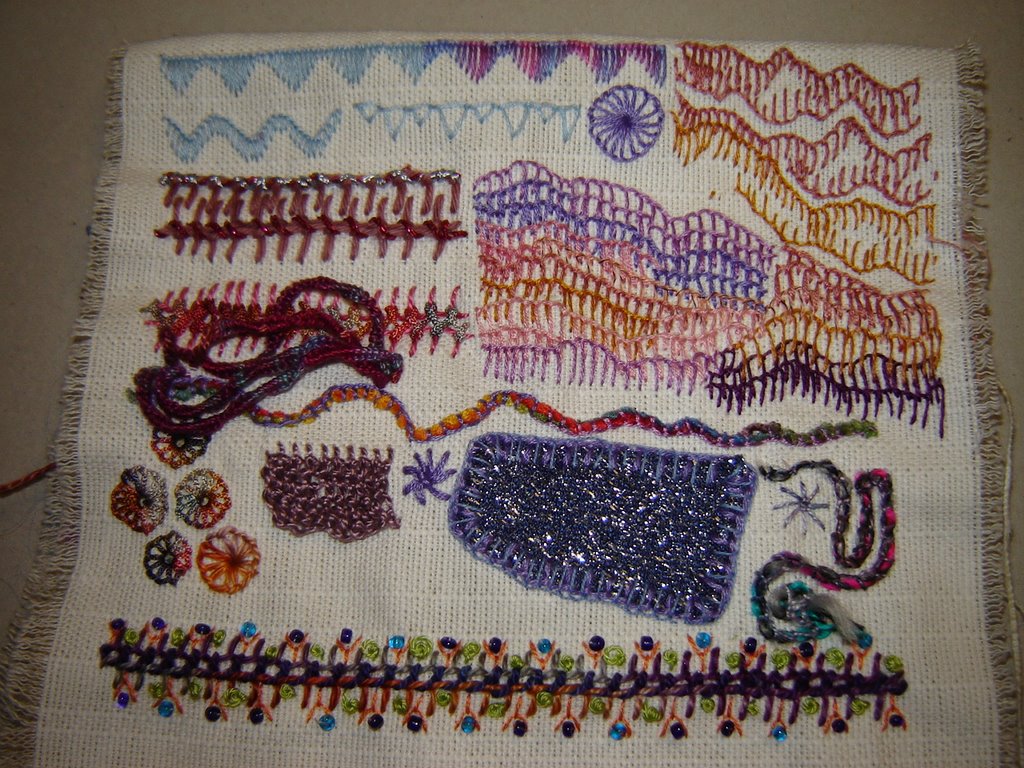
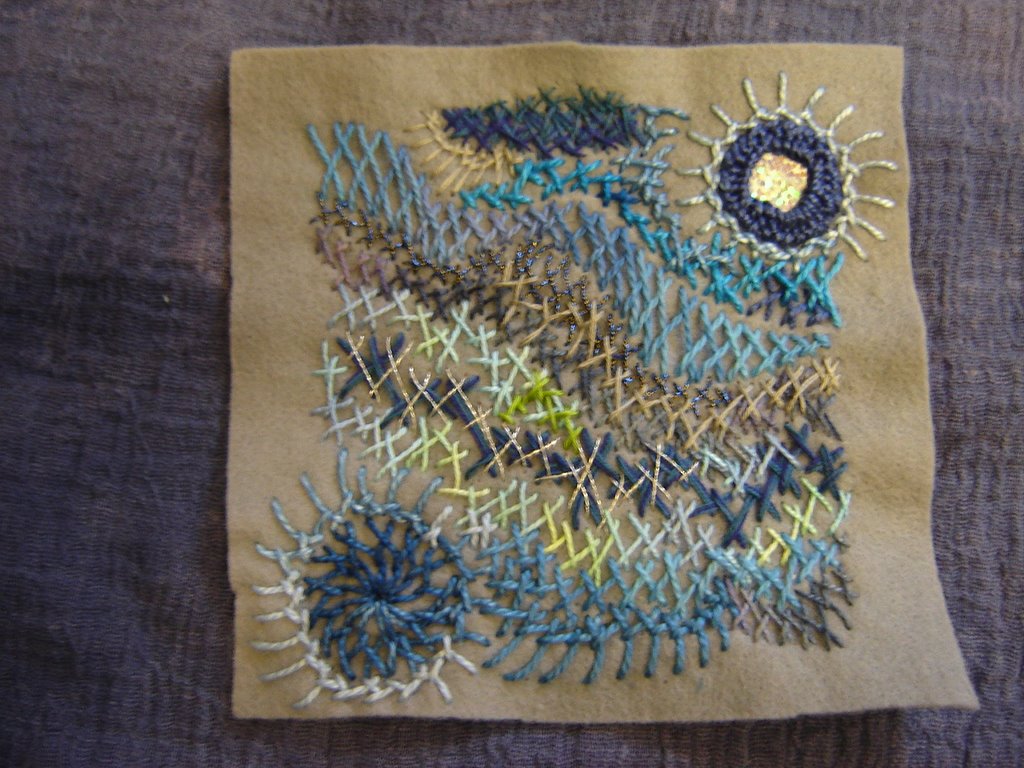
The latest stitches are a bit mixed up here as I had trouble thinking of things to do with them really. A bit of zooming will no doubt show scroll stitch, crested chain, portuguese knotted stem and shisha. There are 3 real mirrors which don't show up well, (one is half hidden by cast-on and drizzle stitches, which I can't help going back and adding to) and the glittery bit is some sequin waste. For UK stitchers who like a bargain, try the children's craft section in Tesco Extra - they have a pack of 4 different, very long rolls of sequin waste for peanuts (£1.97) I also tried using scroll stitch lines to fasten down some of it.

Saturday, January 20, 2007

TAST detached chain . . .

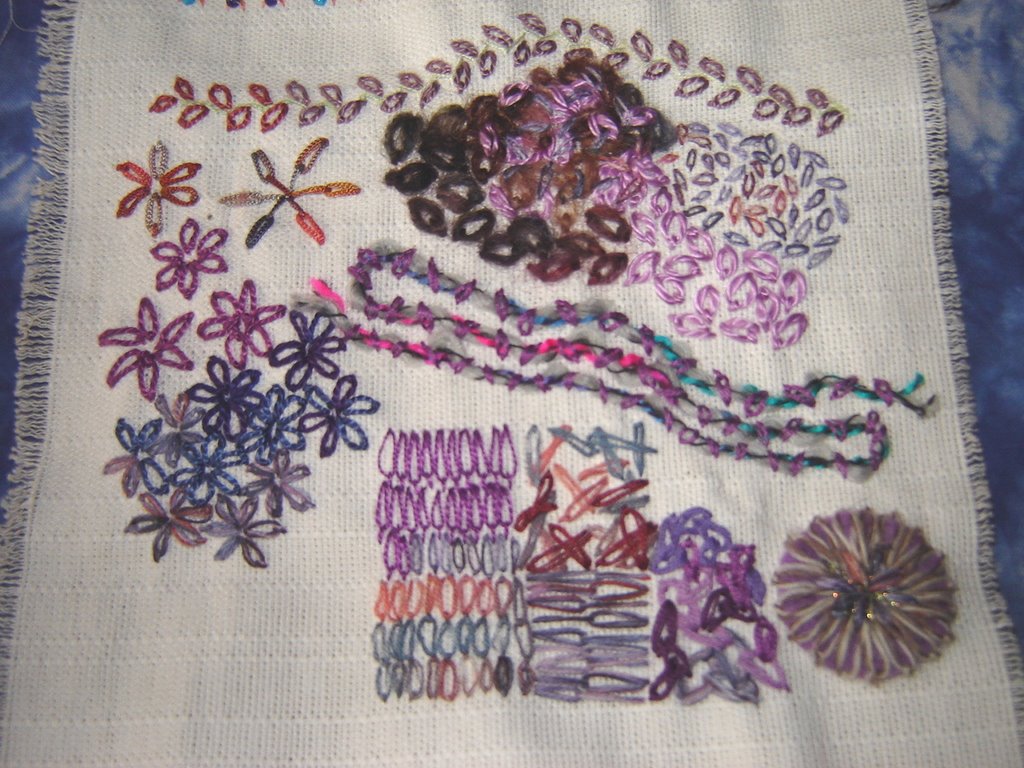
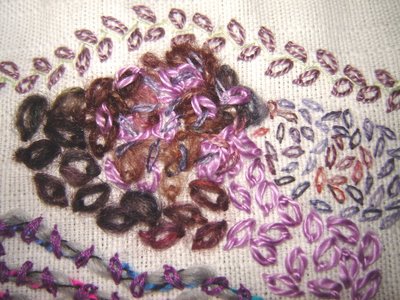
I found it hard this time to think of variations with this stitch for myself . Except for the curvy line at the top where I was thinking a line in basic chain is obvious, but how could a line be done with separate stitches? And then I tried flowers, using the stitch both ways round, and one with long tie stitches. Also the textural 'jumble' of different threads. Then some couching. Also Sharon's padded flower. Then I resorted to Google and came across Velvet Stitch and an interesting sampler of detached chain, from which I have copied some ideas.

I still want to try some of the variations of chain stitch done as detached stitches e.g. twisted chain etc.
And if anyone please could give me advice on how best to work a 'jumble' of stitches? I found it more baffling than I expected, and I'm usually not bad at random!

Sunday, January 14, 2007

New buttonhole sampler . . .

. . . completed this Sunday evening, 19.15 GMT. Looking at Sharon's counted thread samples I was struck with how different the stitch looks worked on that sort of cloth. I tried counting threads on my sampler strip but it proved to be too small for comfort and my eyes were hurting with the effort, so I gave up after two tries. Other bits are buttonhole wheel, done both ways round, couching, appliqué and a small detached stitch piece.

I particularly like the twisty lines top right, the filled areas, the laced back to back rows, the buttonhole bars and the eyelets below the bars (yes, they do have a hole in the middle, hard to see). I've also decided to try and use each stitch in a complex seam, as an interesting exercise , but I think this one could be nicer really.

Buttonhole stitch . . .

I've had a bit of a rest after last week's marathon - these pics were not done for TAST but for a hands-on session at the Macclesfield Embroiderers' Guild meeting in November where we could choose one out of five different stitches to play with. I was in charge of the buttonhole table and did these samples of a range of possible variations. So I haven't worked them again for TAST, but in my next stitchy post there will be a smaller sampler with some further interesting applications.
Using buttonhole to fill a space is interesting. If you work from the bottom (here, right), of the space, each following row will come over the ridge of the stitch and give a smooth effect.Doing it the other way round, from the top of the space down, you keep the ridges. These were circular pieces because they were in a small round frame. Obviously need finishing. One day! And this one, just 2 lines of buttonhole, but I like the effect of the space between them.

Herringbone update . . .

I added a bit more to the freeform herringbone sample for Sharon b's TAST challenge. Around the mirror top right and at the bottom of the piece are some of the extended stitches I was talking about in the last post.

Friday, January 05, 2007

Take a Stitch . . . .

I'm not going to be able keep up this speed, you can be sure, but, while the going is good, here's my first response to Sharon Boggon's Take a Stitch Tuesday. Each week she is putting up a stitch to experiment with and over 100 people are participating. The first one this week is herringbone:
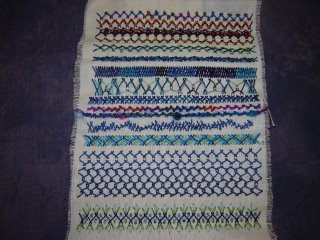
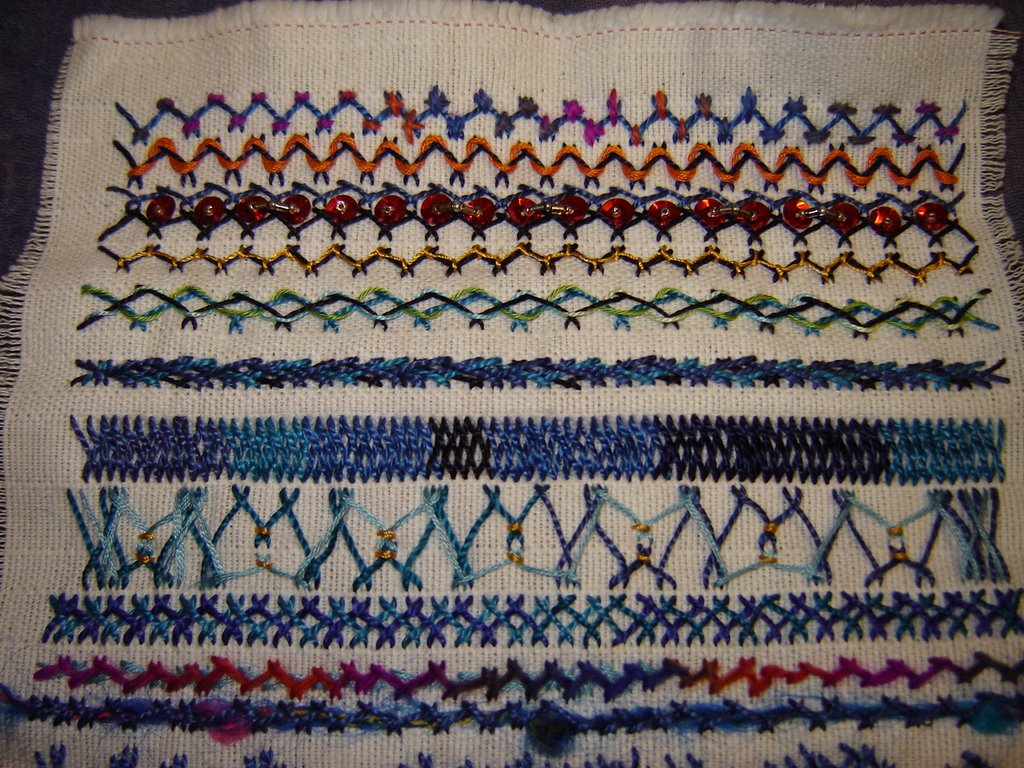
I've chosen to use a long strip from a curtain fabric remnant as my main 'sampler', hoping to end up with a long scroll of stitch experiments. Usefully for this particular stitch the fabric is woven with countable threads and heavier lines in the weave across the strip which form stripes of varying but regular sizes. So for once in my stitching life I can get straight lines and even-sized stitches!
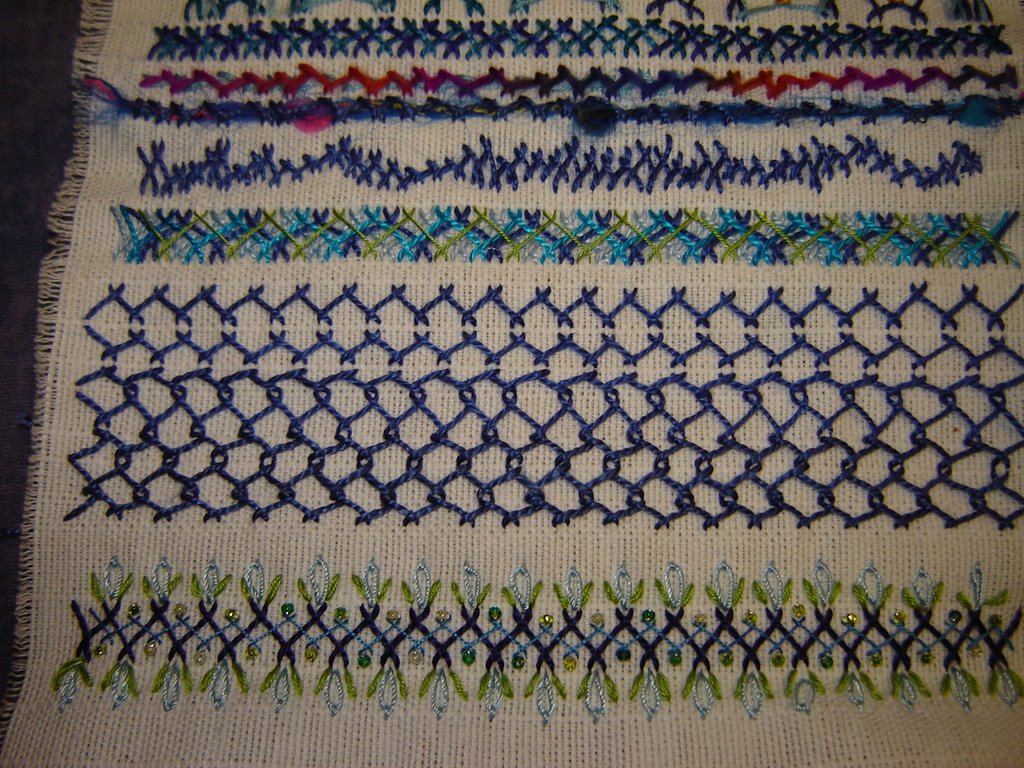
I've worked the stitch in, mostly, regular fashion, laced it, repeated it to make overall patterns (which remind me of chicken wire!), tried it close together, stretched out, doubled/trebled /quadrupled. And I've worked a line as if it were a seam treatment in crazy patchwork.
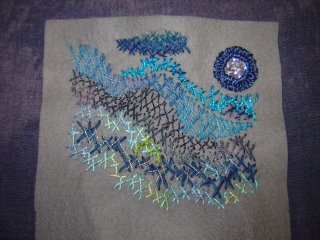
It all looks very sedate for me, but I have broken out with some very irregular stuff on a separate piece, below. The idea is to create texture, varying threads, length and angle of stitch, but keeping to the essential movement of the stitch where the needle is being pushed in backwards but the thread is taken forward to advance the line of stitching against the direction of the needle (if you see what I mean?)
I also remembered seeing herringbone used to sew on mirrors. This is a large holographic sequin. If pushing the needle under the grid of threads that hold the mirror in place counts as the top part of the stitch, then I guess it would count .

I've seen a lengthened form of herringbone used in Indian work, in a copy of Stitch (with the Embroiderers' Guild) magazine, which I shall try out when I can find it.

Later in the day, have found a small picture, in Stitch issue 33, Feb/March 2005. There are 2 articles in the mag., one a project by Surjeet Husain, and one about her and her work. On the link page the last small pic of all shows this stitch. Best I can do.

Tuesday, December 19, 2006

Doodlestrips


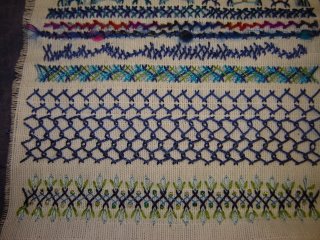
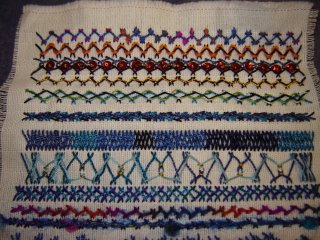
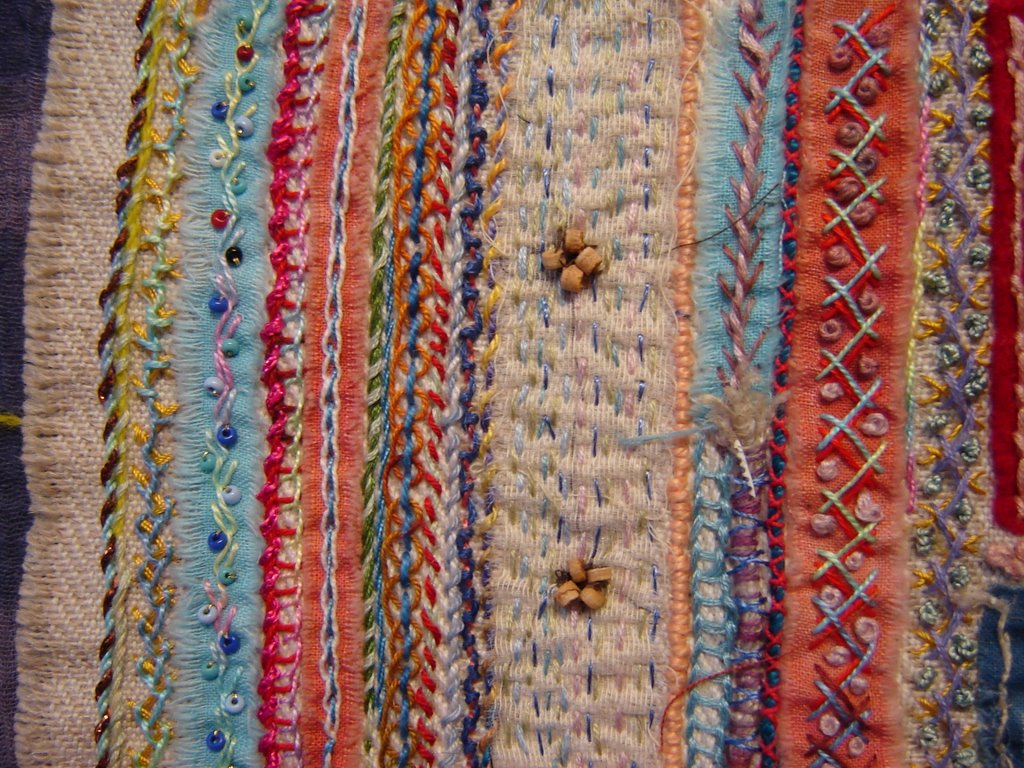
My version of the embroiderer's equivalent of doodling with pen or pencil during meetings and telephone conversations. You thread a needle, select a stitch and sew till the thread runs out. Then you take another thread . . . . and sew on and so on. Sorry! Occasionally I've used it to try out a new stitch, but that is not the main purpose, unlike similarly named 'doodle cloths'. I've used up ends of thread left from something else. Waste not want not, which anyone brought up during rationing will know something about. But mostly it is simply a means of satisfying that urge just to be stitching, but without having to work out a design first, or, in fact having to make any preparations at all. Don't work it out, just do it.